

Majority of companies in Singapore yet to fully measure supply chain emissions: Schneider Electric survey
- 78% of business leaders from small companies claim they have lost current or potential business opportunities
- Vast majority welcome stronger support announced by Deputy Prime Minister Lawrence Wong in Budget 2024 to accelerate sustainability goals and green supply chains
- 91% are positive about the new S$5billion Future Energy Fund
Singapore, 8 May 2024 – A new study by Schneider Electric, the global leader in the digital transformation of energy management and automation finds that most Singapore businesses are falling short in engaging their supply chain partners to calculate total greenhouse gas emissions (GHG), with nearly two thirds (63%) of business leaders indicating they have not fully measured or analysed these.
Lack of appropriate technology is highlighted as a key barrier, with less than half (44%) of business leaders indicating their companies have all the tools, technologies, and infrastructure needed to easily measure and analyse the carbon footprint of their organisation’s supply chain.
This perception varies across sectors, roles, and seniority levels, with 58% and 56% of board members and C-suite executives indicating this, compared with 25% of senior managers – pointing to a stark gap between those developing supply chain emissions strategies and those implementing them. Similarly, those in general management roles at 55% are far more likely to indicate this than those focused on supply chain at 27%. By industry, those in Singapore’s real estate sector are the most prepared, with 81% achieving full implementation of the technology, tools and infrastructure they need, with engineering and education the least prepared sectors, both at 13%.
The findings come from a March 2024 survey more than 500 senior business leaders in Singapore, involved in leading the sustainability strategies for their organisations. They include board members, C-suite executives, directors, and senior managers, from small, medium, and large multi-national corporations (MNCs) across a range of industries.
Despite gaps in supply chain emissions data, the study finds that Singapore businesses are pressing forward with taking a range of measures to green their supply chains, with 63% switching transportation and/or distribution routes, 55% placing increased requirements on their suppliers, and 47% switching suppliers.
Other steps employed by organisations in Singapore to reduce emissions levels include switching transportation and/or distribution vehicles or modes of transport (36%) and seeking third-party support on sustainability consultation and certification (9%).
SMEs under increasing pressure
The growing momentum of greening supply chains is resulting in challenges particularly for SMEs. 95% of respondents believe it is becoming harder for smaller companies to supply larger companies due to increasing environmental and GHG emissions requirements. Half (50%) say this situation is already occurring – a sentiment shared by 60% of small companies compared with only 48% of large companies.
Specifically, 62% have reported losing existing or prospective new business owing to stringent GHG compliance – with small companies again disproportionately disadvantaged at 78%, compared with 52% of large companies being affected.
Almost half (47%) of overall business leaders surveyed and 57% of small business leaders surveyed agree that it will become significantly more expensive to do business due to increased emissions reduction requirements in supply chains.
To assist suppliers with lowering supply chain emissions, 81% of business leaders said they are providing financial incentives, while 74% are providing access to expertise and 28% are providing training.
Businesses welcome stronger support announced by Deputy Prime Minister Lawrence Wong in Budget 2024 to accelerate sustainability goals and green supply chains
The survey also reveals that businesses in Singapore welcome the stronger support announced by Deputy Prime Minister Lawrence Wong in the Budget 2024 to accelerate sustainability goals and green supply chains.
92% of organisations are positive about the enhanced Partnership for Capability Transformation (PACT) scheme, which will support more collaborations between larger companies and SMEs. 90% believe the scheme will play an instrumental role in incentivising businesses to adopt more energy efficient practices, and a whopping 94% of those whose businesses are eligible intend to apply for it.
90% also agree that the expanded Enterprise Financing Scheme – Green (EFS-Green) scheme will provide the much-needed support to adopt the relevant green solutions required to keep pace with the requirements of MNCs. Almost all (97%) business leaders surveyed note their organisations are likely to apply for this scheme.
The support for this policy comes at a time when access to working capital is presently a major challenge (89%) for Singapore organisations to adopt green solutions. A similar proportion (87%) agree that the scheme will make a sizable difference in supporting Singapore companies with green supply chain participation in the future.
In the same vein, support for other government programmes is promising with 91% of businesses reacting positively to the support outlined in the Energy Efficiency Grant, with 74% of all organisations and all (100%) small companies highly likely to apply for the grant. 93% believe it will be effective in incentivising businesses to adopt more energy efficient practices.
Finally, 91% are positive about the establishment of the S$5billion Future Energy Fund, with 86% believing it will accelerate Singapore’s energy transition.
Yoon Young KIM, Cluster President, Schneider Electric, Singapore and Brunei said, “The gap in technology and infrastructure to sufficiently measure and manage supply chain emissions must be addressed as part of Singapore’s green journey. In particular, more data and training are required to ensure the impact of supply chain adjustments on small businesses can be better managed and wider economic consequences avoided. This will require increasing cooperation between public and private sector stakeholders to manage and it is pleasing to see the positive reaction to the Singapore government’s recently enhanced measures in this area.”
Related Spokespeople
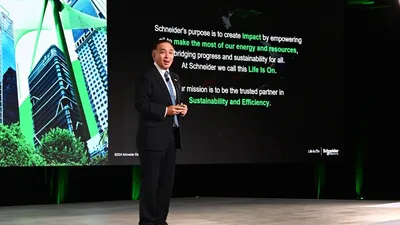
Yoon Young Kim
Cluster President, Singapore and BruneiYoon Young Kim is Cluster President for Singapore and Brunei at Schneider Electric. In his current role at Schneider Electric, Kim seeks to grow company regional presence as the leader of digital and sustainable transformation in energy management and automation. He spearheads efforts to drive more digital solutions, with focus on high-growth potential areas such as Data Centers, Buildings, Infrastructure and Manufacturing. He is also leading efforts in helping customers within these regional markets to operate more sustainably. Kim was most previously Cluster Country President for Vietnam, Cambodia and Myanmar for Schneider Electric – a role he held for over four years from 2016 to 2020. Kim brings with him over two decades of global experience in leading teams across Africa, Asia, Europe, the Middle East, North America, South America, and Russia. This includes experience in the energy management and lighting industries, as well as a strong background in sales and marketing. He boasts a commendable track record of delivering commercial success across emerging markets in B2B, B2C, and B2G fields. As a strategic leader who is people-oriented, Kim is committed to inspiring teams to deliver consistent results in implementing impactful business initiatives and empowering all to make the most of their energy and resources. Beyond his role as Cluster President, Kim holds several board and advisory positions. These include serving as a Board Member of the French Chamber of Commerce in Singapore; a Board Member for UN GCNS (Global Compact Network Singapore); a Board Member at NaviX Solutions by Schneider Electric; and a Global DEI Board Member at Schneider Electric. In addition, Kim acts as a Sustainability Advisory Member to the Board at United Overseas Bank (UOB), one of the world’s leading banks headquartered in Singapore, with branches and offices across 19 countries in the Asia Pacific, Europe, and North America. Kim is fluent in four languages: English, Korean, Portuguese, and Spanish. He graduated from Pontifícia Universidade Católica de São Paulo, with a Bachelor of Business Administration. He also holds multiple postgraduate degrees including a Master of Business Administration from WHU – Otto Beisheim School of Management, Master’s degree at FGV – Fundacao Getulio Vargas in Finance and Post-degree in Marketing from ESPM Escola Superior de Propaganda e Marketing. Kim was born in Korea, raised in Brazil, and now Singaporean.Read more
Attached files
Majority of companies in Singapore yet to fully measure supply chain emissions_FINAL.pdf
PDF, document20/06/2024View asset
Contact press

Schneider Electric Singapore Media Relations
schneiderelectricsg@sandpipercomms.com
Adoption of Wiztrust's Blockchain Certification Platform
From 2nd October 2019, in order to secure its communication, Schneider Electric has been certifying its content on Wiztrust. You can check the authenticity on the website Wiztrust.com for corporate communications.
