


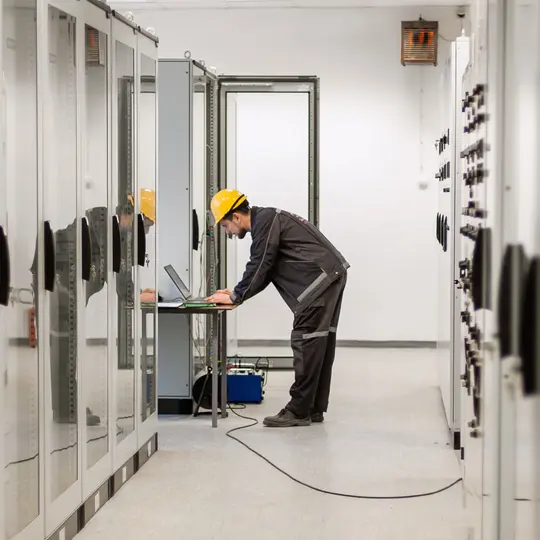
SUMMARY: Switchgear controls and protects electrical equipment. Learn the basics of switchgear, how they differ from switchboards, and how to help your switchgear last longer.
What is switchgear?
Switchgear is a combination of electrical switches, fuses, and circuit breakers housed in a protective enclosure that controls, protects, and isolates power systems. It's most critical in facilities with electrical fault risk or frequent maintenance needs, such as industrial plants and utilities.
Switchgear contains fuses, switches, and other power conductors. However, circuit breakers are the most common component found in switchgear. During an electrical fault, a circuit breaker will sense the anomaly and interrupt the power flow, effectively limiting damage to the system.
Because it’s designed to control the flow of power, switchgear plays a role in enhancing a facility’s energy efficiency and safety.
Use this information on switchgear to
- Learn the types of electrical switchgear
- Differentiate between switchgear and switchboards
- Extend the life of your facility’s switchgear
How does switchgear work?
Switchgear continuously monitors the electrical system for faults such as short circuits, overloads, or ground faults. When a fault is detected, the circuit breaker interrupts current flow within milliseconds, isolating the affected section while the rest of the system stays energized. Once the issue is resolved, the circuit can be safely re-closed and re-energized. This fault detection and interruption process is what allows facilities to prevent equipment damage and avoid full-system outages from a single fault.
Key components of switchgear
- Circuit breakers – interrupt current during faults to protect equipment and personnel
- Fuses – melt to break the circuit when current exceeds a safe threshold
- Disconnect switches – physically isolate equipment from the power supply for safe maintenance
- Relays – monitor electrical parameters and trigger protective action when conditions are abnormal
- Control panels – centralize monitoring and control for the switchgear system
What are the types of electrical switchgear?
Most applications require either low voltage switchgear or medium voltage switchgear.
Low voltage switchgear is used across multiple industries such as healthcare, industrial buildings, and water/wastewater to regulate systems up to 1 kilovolt. Depending on your facility’s specifications, you can incorporate different product features, including:
- Arc-resistance
- Front access
- Space-saving design
Key components of switchgear
Indoor and outdoor systems up to 75 kilovolts use medium voltage switchgear. Since applications and budgets vary, medium voltage equipment comes in three insulating technology options:
- Gas-insulated switchgear
- Air-insulated switchgear
- Shielded solid switchgear
Insulators protect the components within the switchgear and often provide a cooling function.
Is there a difference between switchgear and switchboards?
Although many use the terms interchangeably, there are differences between switchgear and switchboards.
Not only does switchgear protect and control the power supply, but it also can disconnect from a power supply during a fault. On the other hand, switchboards are only used to transmit power to other sources, most often in commercial settings.
Switchgear and switchboards are also designed to handle different voltage capacities. High voltage switchgear can accommodate up to 350 kilovolts, whereas switchboards are rarely designed to handle more than 600 volts.
How can I extend the life of my switchgear?
The lifespan of switchgear depends on the application and environment. However, there are ways to extend the lifespan of this electrical equipment by decades.
These include:
- Regular and preventive maintenance
- Direct replacement of circuit breakers
- Using sensors for continuous monitoring
- Arcflash mitigation
Schneider Electric offers a range of high-performance low voltage switchgear and medium voltage switchgear products solutions for superior energy management.


Need help?
Product Selector
Quickly and easily find the right products and accessories for your applications.
Get a Quote
Start your sales inquiry online and an expert will connect with you.
Where to buy?
Easily find the nearest Schneider Electric distributor in your location.
Help Center
Find support resources for all your needs, in one place.